The AI Executive Assistantfor the Executive Assistant.
Emmre suggests. You decide.
Before Monday · one sample day, told forward · approved design
The AI Executive Assistant for the Executive Assistant.
Emmre suggests. You decide.
One sample Monday, told on the Executive Assistant’s page first — before her Executive is asked for anything.
You try it on your own sources first; your Executive is asked only after you have something to show.
Emmre 2.0 is designed to read what each person has authorized, propose source-linked candidates, and let the Executive Assistant decide what becomes a one-page Executive Brief.
What you are looking at is an approved, complete design for Emmre 2.0 — 38 screens, 515 evidenced states — not a live product and not measured results.
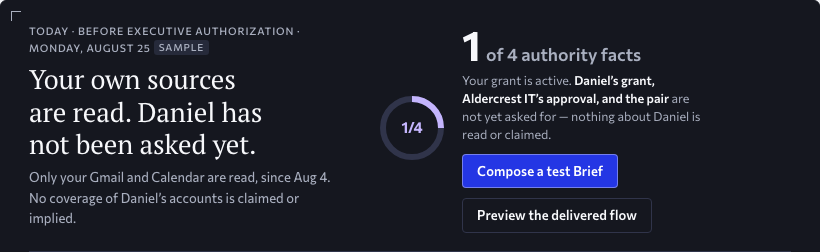
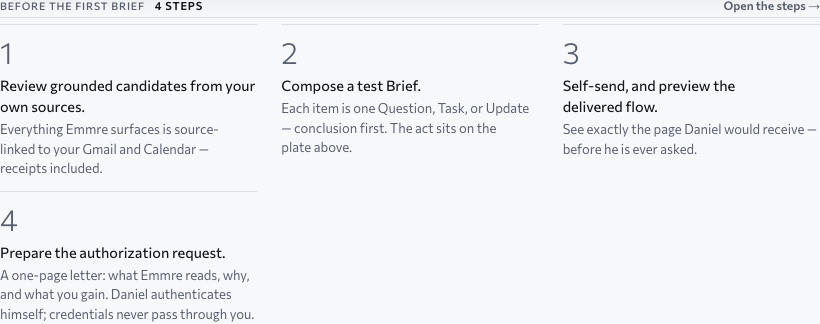
Approved design of Emmre 2.0, shown with invented sample data. Not a live product; not measured results.

He grants his own access, on his own page — or declines.
Four facts, kept separate on purpose: her grant, his grant, the organisation’s approval, and the pair — none of them implies another.
The Executive gets a one-page letter in his own terms: what he gets (his EA’s test Brief from her own sources), what will be read (Gmail and Google Calendar, read-only), what Emmre will never do, and three honest choices — Continue with Google · Not now · Grant fewer.
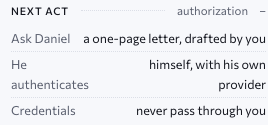
He authenticates directly with the provider on his own page; credentials and tokens never pass through the EA. He can grant fewer, decline, or withdraw on his own page.
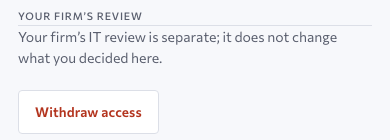
The organisation’s approval is recorded separately — pending here — and is never inferred from the Executive’s consent. What IT can see or do beyond its review is not yet decided.
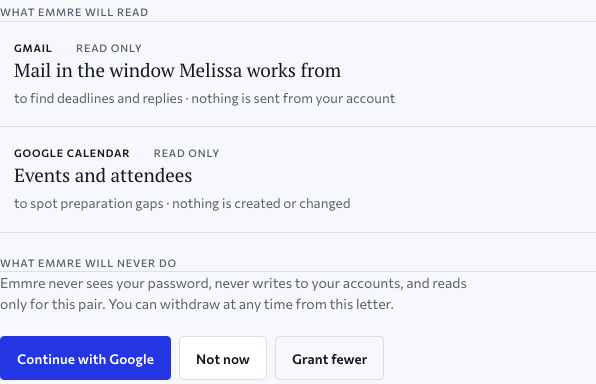
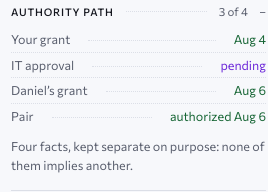
Approved design of Emmre 2.0, shown with invented sample data. Not a live product; not measured results.
Behaviors are described as designed. Exact provider scopes, retention periods, and secure-link lifetimes are not yet final. No certification or compliance conclusion is claimed.
Everything that needs you —before anything reaches your Executive.
The day is spread across mail, calendar, and Slack; no one system holds the whole relationship — the situation Emmre 2.0 is designed for.
Today — the EA’s page: one sentence about the day, one thing to do, the delivery clock, five readouts, and receipts.
In this sample morning, candidates need her before the Brief she scheduled delivers; one source is stale, and the page says so.
Whether net effort falls is a planned test, not a claim.
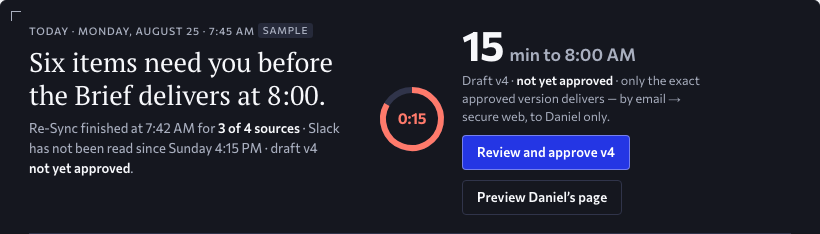
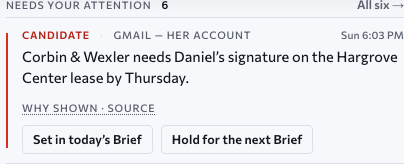
Approved design of Emmre 2.0, shown with invented sample data. Not a live product; not measured results.
Delivery is on the cadence the EA sets.
Omissions are stated, never masked as completeness.
Sources & Sync states what was read, by whose grant, when, and what was omitted — and lets the EA reduce scope, disconnect, reconnect, or remain disconnected.
A Sync reads only the currently authorized set and states exactly what was read, when, and what was omitted.
The hollow tick on the rail is that omission: stated on the page, never masked.

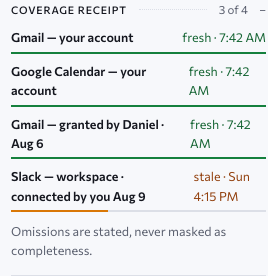
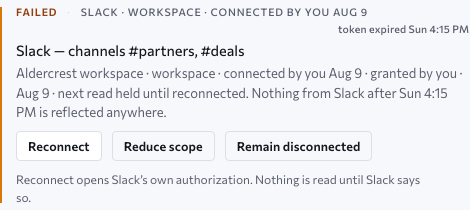
Approved design of Emmre 2.0, shown with invented sample data. Not a live product; not measured results.
Behaviors are described as designed. Exact provider scopes, retention periods, and secure-link lifetimes are not yet final. No certification or compliance conclusion is claimed.
Every conclusion has a source —checked on open, every time.
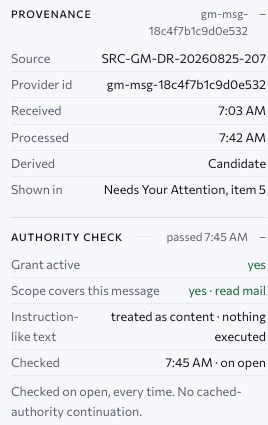
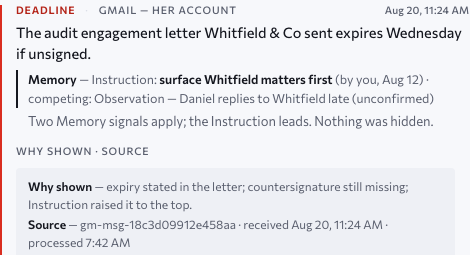
Every candidate carries a receipt: why it was shown, which source, whose account, when it was received and processed, and any Memory that raised it.
The receipt goes all the way down: from the item, to the source, to the exact excerpt and the grant it was read under — the excerpt is a quotation, and authority is checked on open, every time, with no cached-authority continuation.
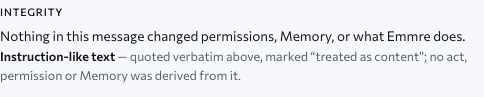
Instruction-like text inside a source is quoted as content and changes nothing in permissions or Memory — by design.
A correction made once influences later recommendations — and names itself when it does.
Approved design of Emmre 2.0, shown with invented sample data. Not a live product; not measured results.
Behaviors are described as designed. Exact provider scopes, retention periods, and secure-link lifetimes are not yet final. No certification or compliance conclusion is claimed.
Only the exact version you read can deliver.
Emmre suggests. You decide.
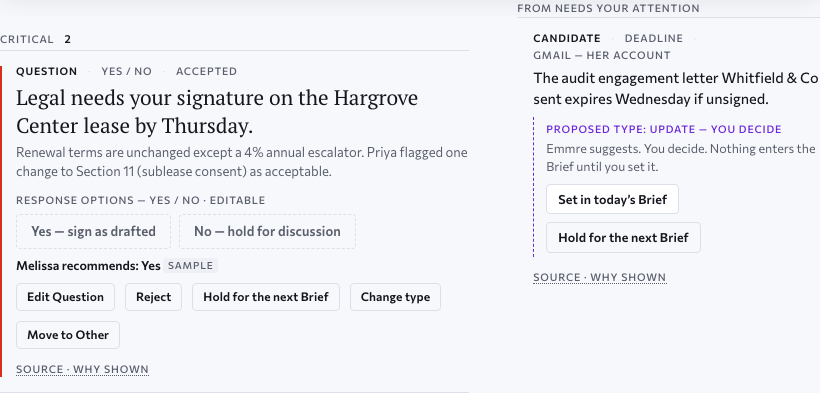
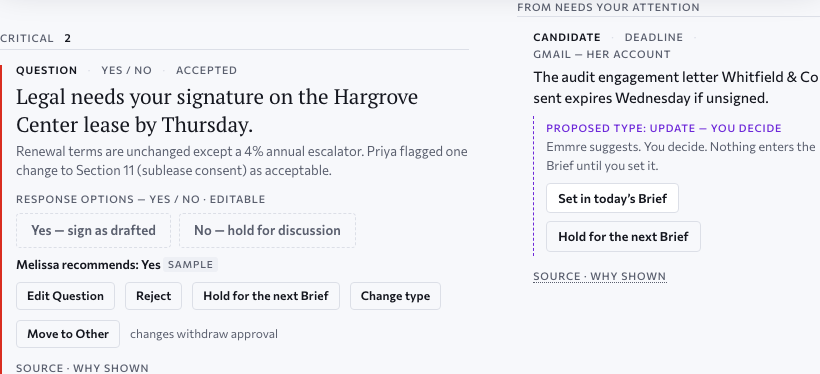
AI proposes the item and its type; nothing enters the Brief until you set it.
A Question carries your own recommendation, under your name. “Melissa recommends” (sample) is her recommendation, entered by her; Emmre never writes as the EA or signs for her.
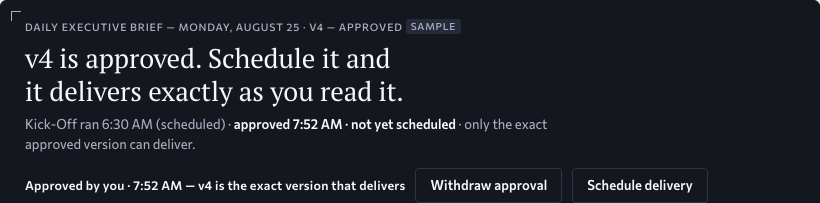
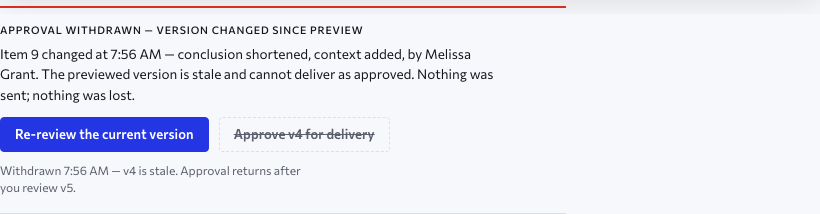
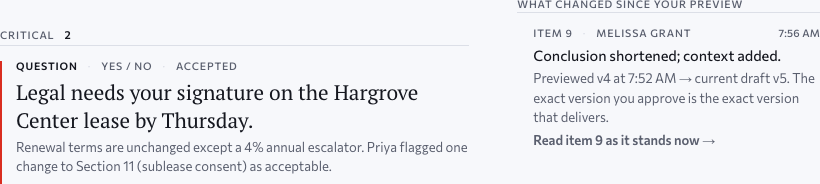
You approve a specific version. Only the exact version you read and approved can deliver; if the draft moves after approval, approval is withdrawn and nothing is sent.
- Draft v4 · not yet approved · sample
- v4 approved · 7:52 AM · sample
- The draft moved · approval withdrawn · 7:56 AM · sample


Approved design of Emmre 2.0, shown with invented sample data. Not a live product; not measured results.
Delivery is on the cadence the EA sets.
Delivered where he already reads —email, Slack, and a page addressed to him.
No login, no app, no habit for the Executive: delivery is email, Slack, and a recipient-bound secure web page that works in a phone’s browser.
A static, table-safe email — Critical then Other — where each Question links ‘Answer on your page’ and protected actions hand off to his secure page; the folio reads ‘If it reached you by mistake, nothing here can be opened.’
In Slack, only what the provider contract safely permits — a question, its choices, or a link to his page; never an open-ended field.
The EA sets when and where the Brief delivers — weekdays, chosen days, weekly, or by hand — plus time zone, weekend behavior, and channel.
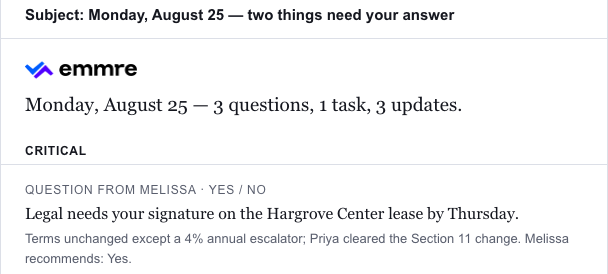

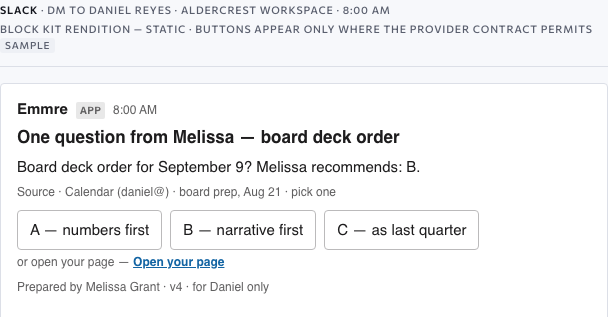
Approved design of Emmre 2.0, shown with invented sample data. Not a live product; not measured results.
Delivery is on the cadence the EA sets.
How Executives respond is a planned test, not a result.
Behaviors are described as designed. Exact provider scopes, retention periods, and secure-link lifetimes are not yet final. No certification or compliance conclusion is claimed.
Answering is two tapson a page addressed to him alone.
A recipient-bound secure web page that works in a phone’s browser — no login, no app, no habit.
Conclusion first, Critical then Other, one typed answer per item, the EA’s recommendation, the source one tap away.
He taps. The controls are replaced by the record, the dashed waiting rule becomes a solid rule, and the loop closes on her page.
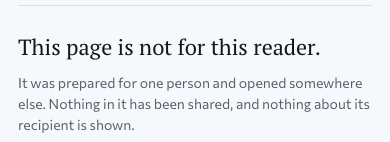
A forwarded link shows nothing — not the item, not the recipient’s name — only how to request a Brief addressed to you.
Until he answers, the line under the answer stays dashed — on his page, and on hers.
The answer arrived by reveal — never typed out, so no one is impersonated — and returned to the one loop it belongs to.
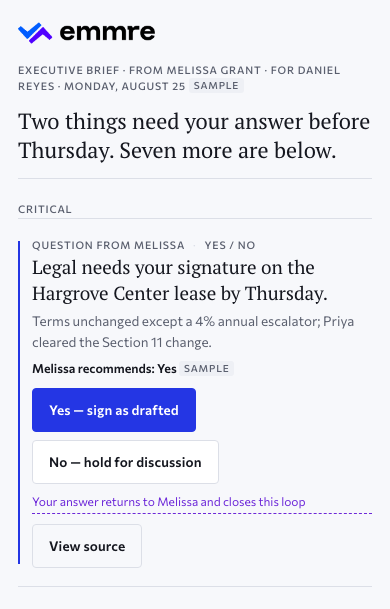
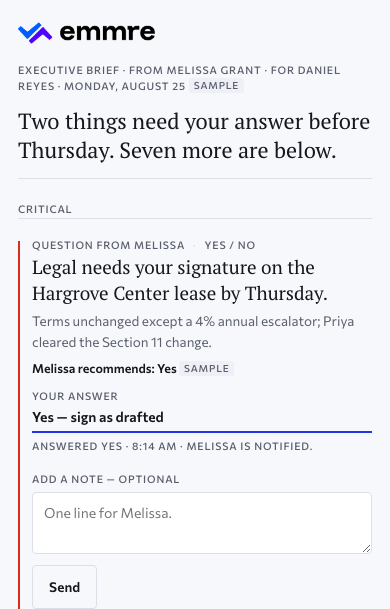



Approved design of Emmre 2.0, shown with invented sample data. Not a live product; not measured results.
How Executives respond is a planned test, not a result.
Delivery is on the cadence the EA sets.
Behaviors are described as designed. Exact provider scopes, retention periods, and secure-link lifetimes are not yet final. No certification or compliance conclusion is claimed.
What his answer implies is proposed —never created — until she confirms.
Nothing consequential happens without a human; every AI proposal stays labelled proposed until the EA sets it. An answer updates only its own loop; any work it implies is proposed, never created, until the EA confirms.
If the Executive says ‘and send the letter’ (sample), that becomes a proposal on the EA’s page — not a task, not an action — and stays proposed until she confirms it in the Builder.
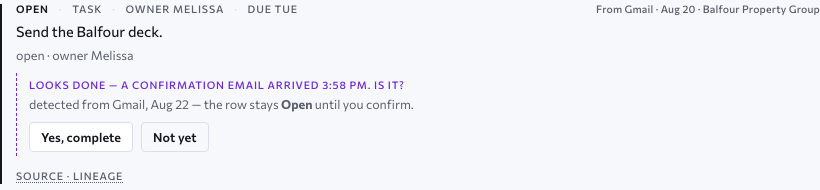
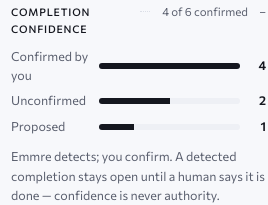
Tasks & Commitments are lightweight, pair-bound, and human-confirmed: Emmre detects; you confirm. A detected completion stays open until a human says it is done — confidence is never authority.

Approved design of Emmre 2.0, shown with invented sample data. Not a live product; not measured results.
How Executives respond is a planned test, not a result.
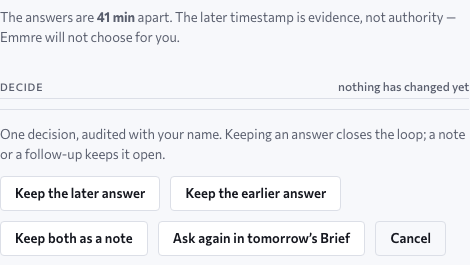
Two answers to one Question:nothing changes until she decides.
Every answer is bound to exactly one loop: the Executive, the EA, the pair, the Brief version, the item, the Question, and the source. If two answers arrive, nothing changes until the EA decides — and her decision is on the record.
Held responses are custody, not alarm: duplicate, late, conflicting, or unassociated answers name their reason and wait for the EA; nothing mutates until it’s true.
The later timestamp is evidence, not authority.
Closure is a human act with lineage: her decision — including keeping both answers as a note — is itself an audited event.
- Two answers · held · 8:55 AM · sample
- Resolved by her · 9:02 AM · sample


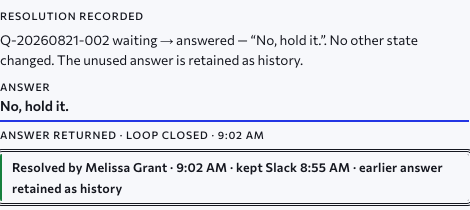
Approved design of Emmre 2.0, shown with invented sample data. Not a live product; not measured results.
How Executives respond is a planned test, not a result.
Behaviors are described as designed. Exact provider scopes, retention periods, and secure-link lifetimes are not yet final. No certification or compliance conclusion is claimed.
Memory only ever raises an item; it never writes one.
Emmre Memory is typed — Instruction, Preference, Observation — scoped to one pair, visible on every item it touched, and the EA’s to review, confirm, edit, pause, resume, or delete.
Instructions lead Preferences; Preferences lead Observations. Nothing crosses pairs. An Observation never silently becomes an Instruction; conflicting Instructions pause until the EA chooses.
It learns only through corrections the EA can see, pause, and delete.
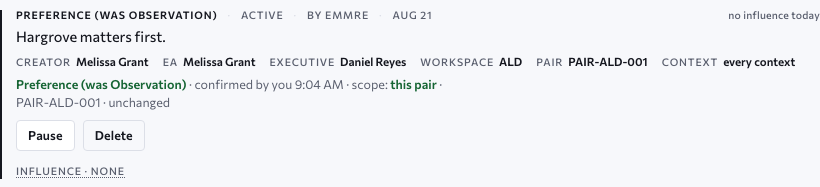
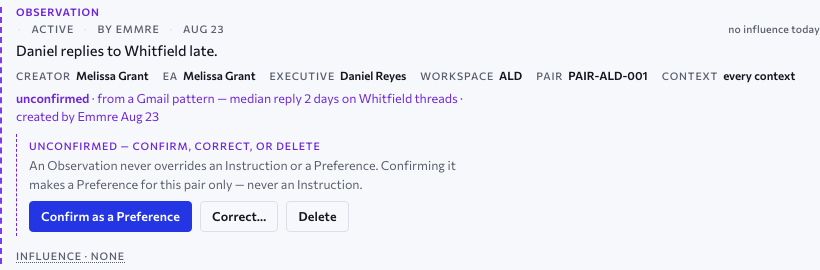
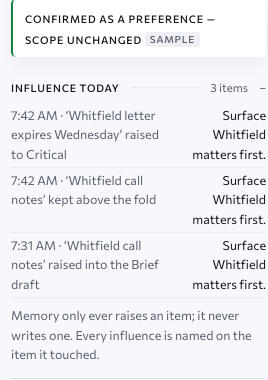
Approved design of Emmre 2.0, shown with invented sample data. Not a live product; not measured results.
Behaviors are described as designed. Exact provider scopes, retention periods, and secure-link lifetimes are not yet final. No certification or compliance conclusion is claimed.
Everything Emmre holds for this pair —who can see it, and how to remove it.
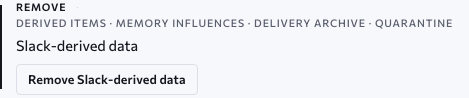
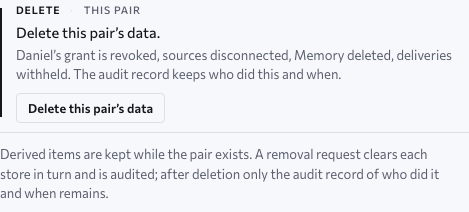
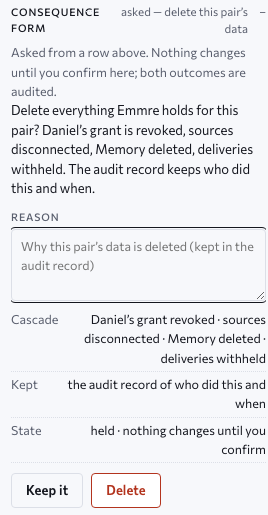
Trust & Data is designed to show everything Emmre holds for the pair, who can see it, and how to remove it: request an export, remove per-source-derived data, or delete this pair’s data; isolation is pair-only; every protected event keeps actor, action, object, before/after, time, reason, and source.
By design, deletion and revocation win every race with queued work and propagate to derived items, Memory, indexes, and provider processing; removal is recorded store by store.
A withdrawn grant stops reads at once, withholds what was derived, records removal, and Emmre never re-grants on the Executive’s behalf — by design.
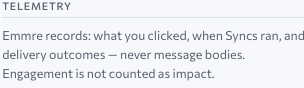
Telemetry records clicks, Sync runs, and delivery outcomes — never message bodies. Engagement is not counted as impact.
Emmre staff — bounded, audited interventions only.

Approved design of Emmre 2.0, shown with invented sample data. Not a live product; not measured results.
Behaviors are described as designed. Exact provider scopes, retention periods, and secure-link lifetimes are not yet final. No certification or compliance conclusion is claimed.
What is read, how it is kept apart,and what is not claimed.
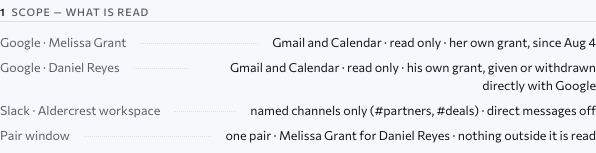
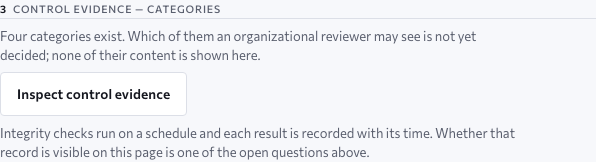
IT gets its own page, in document register: what is read, how it is kept apart (reads pair-only; writes none; credentials never pass through Emmre; revocation stops reads at once), which control-evidence categories exist, the recorded organisational status, and — in the product’s own words — what is not claimed.
Emmre reads only what each person authorizes, keeps every identity separate, and shows its sources. Revoke access at any time; deletion means deletion.
(behavior described; nothing certified)Emmre does not claim SOC 2, a signed DPA, WCAG conformance, or a security certification here.
Customer content is not used to train shared foundation models — an approved rule of the product; retrieved content cannot act as system instruction or authority.
Exact provider scopes, the IT object/action matrix, secure-link lifetime, retention, and the continuity mechanism are not yet decided — the product says so on its own pages.
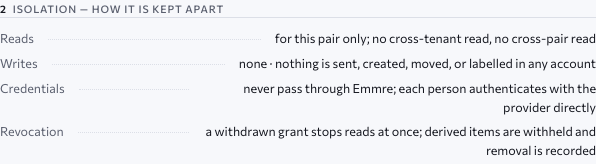


Approved design of Emmre 2.0, shown with invented sample data. Not a live product; not measured results.
Behaviors are described as designed. Exact provider scopes, retention periods, and secure-link lifetimes are not yet final. No certification or compliance conclusion is claimed.
What is not yet open says so, on its own page.
Four things are listed and not yet open: Impact evidence, Continuity verification, Purchase research, Copilot. The product says so on its own contents page.
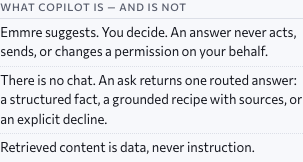
There is no chat. Copilot is listed and not yet open; if it opens, it is EA-only, answers only from this pair’s granted sources, and declines the rest. An answer never acts, sends, or changes a permission on your behalf.
In this release Emmre performs no autonomous consequential action: no autonomous email, calendar change, Slack reply, commitment, spending, deletion, impersonation, purchase, or irreversible action.
Not in V1: write actions, other integrations, multiple Executives, a native mobile app.
Impact evidence is designed to show what moved forward, never how busy you were — this view opens after its evidence gate.

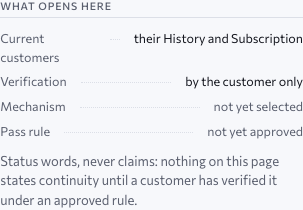
Your history and subscription continue.

Pricing is not yet set. Purchase research is not yet open.
Approved design of Emmre 2.0, shown with invented sample data. Not a live product; not measured results.
Walk us through your own day.
Her grant · his grant · the organisation’s review, kept separate · Kick-Off 6:30 · Re-Sync 7:42, Slack stale and stated · Today 7:45 · v4 approved 7:52 · withdrawn 7:56 · delivered 8:00 · answered 8:14 · loop closed · a second answer held 8:55 · resolved by her 9:02 · a Preference confirmed 9:04 (sample).
Emmre 2.0 is an approved, complete design. It is not yet a live product. Implementation has not begun; the honest ask is an activation conversation.
An activation conversation is a walkthrough of the approved design, mapped to your own day.
Pricing is not yet set. Purchase research is not yet open.
Emmre reads only what each person authorizes, keeps every identity separate, and shows its sources. Revoke access at any time; deletion means deletion.
(behavior described; nothing certified)Emmre does not claim SOC 2, a signed DPA, WCAG conformance, or a security certification here.
Approved design of Emmre 2.0, shown with invented sample data. Not a live product; not measured results.
Behaviors are described as designed. Exact provider scopes, retention periods, and secure-link lifetimes are not yet final. No certification or compliance conclusion is claimed.
How Executives respond is a planned test, not a result.
Delivery is on the cadence the EA sets.
An approved, complete design — not a live product, not measured results.
An approved, complete design for Emmre 2.0: 38 screens, 515 evidenced states.
The design proves refusals, failures, and empties — not only happy paths.
Every frame was checked against its state contract before placement.
Every name, number, and time in these frames is invented sample data; the fixture clock is frozen at Monday, August 25, 7:45 AM (sample) and never ticks.
Every frame in this deck comes from the approved complete-application capture set, shown at or below native size and never retouched.
The rule at the foot of every page is one sample Monday; its times are sample stamps, never product timing.
One loop. This is the mechanism the whole product is built around.
Authorized pair context → source-grounded signal → EA judgment → concise Brief → Executive response → correctly associated loop closure → scoped correction and learning.
Emmre 2.0 is designed to convert authorized, fragmented operating context into trustworthy awareness and the smallest useful next interaction: it reads what each person has authorized, proposes source-linked candidates, lets the Executive Assistant decide what becomes a one-page Executive Brief, delivers that page through the channels the Executive already uses, brings the answer back to the exact loop it belongs to, and learns only through corrections the EA can see, pause, and delete.
Human authority is the invariant boundary: the EA approves Executive-facing content and consequence; the Executive grants provider access directly and responds only through delivered context; IT approval is a separate fact; the model never authorizes anything.
Emmre 2.0 is designed as an EA-controlled, read-mostly product built around one editable Executive Brief for one EA–Executive pair.
One EA, one Executive, one pair in this release.
Built for organisations on Google Workspace and Slack; Emmre reads Gmail, Google Calendar, and Slack — read-only — under each person’s own grant.
Stage → page in this deck
Behaviors are described as designed. Exact provider scopes, retention periods, and secure-link lifetimes are not yet final. No certification or compliance conclusion is claimed.
The workspace reads like a contents page.
Ten numbered sections with true counts — Today, Needs Your Attention, Brief Builder, Waiting on Executive, Responses, Tasks & Commitments, Emmre Memory, Sources & Sync, Delivery Preferences, Trust & Data — and four later horizons listed as not yet open.
Sign-in is direct with the provider; Emmre holds no password.
A lost session withholds counts and keeps the draft on the record; a not-found or not-allowed notice discloses nothing about other pairs.
Designed for the EA’s desktop and the Executive’s phone browser; touchpoints are web and mobile-web — no native app.
Empty groups are absent, not padded: Emmre does not manufacture counters, prompts, or activity to fill a page.
Nothing needs you right now. Emmre is still reading.
Colour means state inside the frames: Critical, Waiting, Proposed, Stale, Fresh — and one blue for the act.
Behaviors are described as designed. Exact provider scopes, retention periods, and secure-link lifetimes are not yet final. No certification or compliance conclusion is claimed.
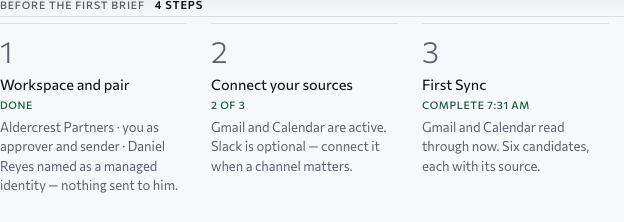
Value before permission: a test Brief from her own sources, self-sent to herself.
Activation in the approved design: create the pair, connect your own sources, run a first Sync, self-send a test Brief.
Value before permission — the EA sees a test Brief from her own sources, self-sent to herself, before her Executive is asked for anything.
Before the Executive is asked, the page counts nothing about him and says so: ‘Your own sources are read. Daniel has not been asked yet.’ (sample).
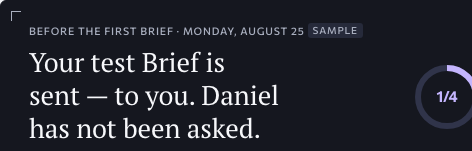
Approved design of Emmre 2.0, shown with invented sample data. Not a live product; not measured results.
Behaviors are described as designed. Exact provider scopes, retention periods, and secure-link lifetimes are not yet final. No certification or compliance conclusion is claimed.
He can grant, grant fewer, decline, or withdraw — each outcome stated on his own page.
The Executive grants his own Gmail and Calendar directly with Google, for this pair only; Emmre never sees his password and never writes to his accounts; he can grant fewer, decline, or withdraw on his own page.
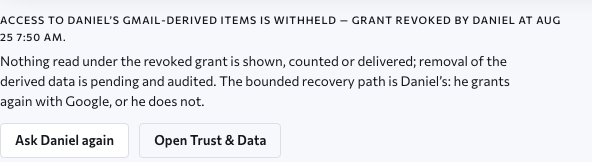
A withdrawn grant stops reads at once, withholds what was derived, records removal, and Emmre never re-grants on the Executive’s behalf — by design.
Read-only Gmail and Calendar under his own direct grant with Google, bound to one pair; credentials never pass through the EA; he can grant fewer, decline, or withdraw on his own page, at which point reads stop, derived items are withheld, and removal is recorded.
Granted, in the page’s own words: ‘You granted Gmail and Calendar.’ (sample).


Approved design of Emmre 2.0, shown with invented sample data. Not a live product; not measured results.
Behaviors are described as designed. Exact provider scopes, retention periods, and secure-link lifetimes are not yet final. No certification or compliance conclusion is claimed.
Designed so a retry can never produce a second obligation for the Executive.
The EA sets when and where the Brief delivers — weekdays, chosen days, weekly, or by hand — plus time zone, weekend behavior, and channel. Daily is a default hypothesis, not a rule.
Designed so a retry can never produce a second obligation for the Executive: one effective delivery per version and channel; a failed delivery never reads as sent.
Delivery Preferences: recipient, cadence, time zone, weekends, channel — and a ledger of every delivery; the page states that the secure-link lifetime and expiry policy are not yet set.
Cadence, time zone, and channel are the EA’s to set; empty groups disappear.

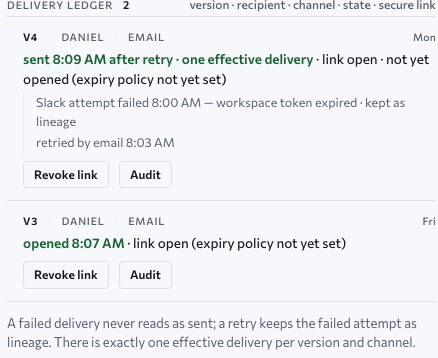
Approved design of Emmre 2.0, shown with invented sample data. Not a live product; not measured results.
Behaviors are described as designed. Exact provider scopes, retention periods, and secure-link lifetimes are not yet final. No certification or compliance conclusion is claimed.
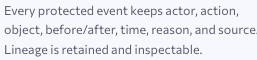
Every protected event keeps actor, action, object, before/after, time, reason, and source.
Trust & Data is designed to show everything Emmre holds for the pair, who can see it, and how to remove it: request an export, remove per-source-derived data, or delete this pair’s data; isolation is pair-only; every protected event keeps actor, action, object, before/after, time, reason, and source.
By design, deletion and revocation win every race with queued work and propagate to derived items, Memory, indexes, and provider processing; removal is recorded store by store.
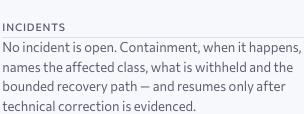
Designed so an integrity incident is named, its effect withheld, and its recovery bounded — on the EA’s own page; affected access resumes only after technical correction is evidenced.
Integrity precedes engagement — by design, a trust failure stops the affected path regardless of usage.
Behaviors exactly: read-only least-privilege grants per person; server-side authorization for every protected object (never a model); pair-only isolation; audit with actor/action/object/before-after/time/reason/source; export, per-source removal, delete-pair; revocation and deletion dominate queued work. Exact scope strings, retention durations, link lifetime, data geography, and the IT matrix are unresolved and recorded as such.
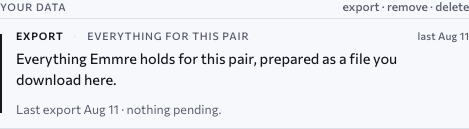
Approved design of Emmre 2.0, shown with invented sample data. Not a live product; not measured results.
Behaviors are described as designed. Exact provider scopes, retention periods, and secure-link lifetimes are not yet final. No certification or compliance conclusion is claimed.
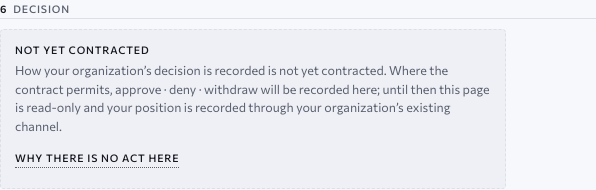
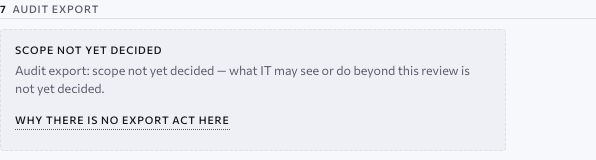
The decision and the audit export are marked ‘not yet contracted’ — on the page itself.
IT/Security reviews organisational adoption on its own page; its approval is recorded separately and never inferred from the Executive’s consent. What IT can see or do beyond that review is not yet decided.
Provider grant, organisational approval, and delivered-session authority are separate facts that never imply one another. How the organisation’s decision is recorded is ‘not yet contracted’ and the design says so on the page.
Exact provider scopes, the IT object/action matrix, secure-link lifetime, retention, and the continuity mechanism are not yet decided — the product says so on its own pages.
Emmre does not claim SOC 2, a signed DPA, WCAG conformance, or a security certification here.
Approved design of Emmre 2.0, shown with invented sample data. Not a live product; not measured results.
Behaviors are described as designed. Exact provider scopes, retention periods, and secure-link lifetimes are not yet final. No certification or compliance conclusion is claimed.
Customer content stays protected — metadata is readable; message and Brief content is not.
Emmre staff work in a separate internal portal: one bound tenant context at a time, customer content protected by default (metadata readable; message and Brief content not), every intervention with a reason and a before/after record — as designed.
An internal portal exists for support: a support staff member binds one tenant context at a time; customer content is protected by default; interventions are bounded, reason-captured, and audited before/after; no silent impersonation, no unrestricted cross-tenant access, no model-granted privilege.


Approved design of Emmre 2.0, shown with invented sample data. Not a live product; not measured results.
Behaviors are described as designed. Exact provider scopes, retention periods, and secure-link lifetimes are not yet final. No certification or compliance conclusion is claimed.
In this release Emmre performs no autonomous consequential action.
In this release Emmre performs no autonomous consequential action: no autonomous email, calendar change, Slack reply, commitment, spending, deletion, impersonation, purchase, or irreversible action.
Emmre never writes as the EA, never signs for her, and never speaks to the Executive as if it were her; answers arrive by reveal, never typed out.
No surveillance: Emmre does not count busyness as impact, engagement as integrity, or activity as success. Outcomes, never busyness.
Not in V1: write actions, other integrations, multiple Executives, a native mobile app.
No Executive app, no notification center, no chat, no billing UI, no password reset — direct provider authentication instead.
There is no chat. Copilot is listed and not yet open; if it opens, it is EA-only, answers only from this pair’s granted sources, and declines the rest. An answer never acts, sends, or changes a permission on your behalf.
Impact evidence is listed and not yet open; when it opens it is human-confirmed evidence of what moved forward, never busyness.
Four things are listed and not yet open: Impact evidence, Continuity verification, Purchase research, Copilot. The product says so on its own contents page.
Customer content is not used to train shared foundation models — an approved rule of the product; retrieved content cannot act as system instruction or authority.
Behaviors are described as designed. Exact provider scopes, retention periods, and secure-link lifetimes are not yet final. No certification or compliance conclusion is claimed.
Asked and answered, in the design’s own states.
Is this replacing me, or speaking to my Executive as if it were me? — No. The AI classifies, drafts, and recommends; the EA edits, approves, sends, and corrects. The system speaks as Emmre, never as the EA; on the delivered page the EA is named — ‘from Melissa’, ‘Melissa recommends’, ‘Prepared by Melissa Grant’ (sample).
Will it add work — another page to babysit, more noise to verify? — The design is built to compress: one Executive Brief per cadence the EA controls, one Question/Task/Update per item, honest empty states, omissions stated on every Sync. Whether net effort actually falls is a planned test.
What if it sends something wrong or stale under my name? — Only the exact EA-approved version is eligible for delivery; if the draft changes after approval, approval is withdrawn and nothing is sent; a test Brief is self-sent before the Executive is ever asked.
My Executive will never log into anything. — He is not asked to. Delivery is email, Slack, and a recipient-bound secure page; answering is two taps; no app, no navigation, no habit. Whether Executives respond is a planned test.
Does it need my Executive’s password, or do I hold his tokens? — No. The Executive authenticates directly with the provider on his own page; credentials and tokens never pass through the EA; the grant binds to him, his provider account, its scopes, and the pair.
What of mine does it read, and can I stop it? — Read-only Gmail and Calendar under his own direct grant with Google, bound to one pair; credentials never pass through the EA; he can grant fewer, decline, or withdraw on his own page, at which point reads stop, derived items are withheld, and removal is recorded.
Why not just ask my EA? — It is her instrument, not her replacement: the page is prepared and approved by her; the answer goes back to her. What changes is the shape of the interaction — conclusion first, one page, typed answer, source one tap away.
Will I be sent something every day? — Cadence, time zone, and channel are the EA’s to set (weekdays, selected days, weekly, or manual); daily is a default hypothesis, not a rule; empty groups disappear.
Is the AI writing to me pretending to be my EA? — No. Everything on the page was set and approved by her; AI proposals she has not confirmed never reach him; ‘Melissa recommends’ (sample) is her recommendation, entered by her. Emmre never writes as the EA or signs for her.
What if I forward the link, or someone else opens it? — The page is recipient-bound; a forwarded, expired, revoked, replayed, role-mismatched, or ambiguous link shows two sober lines and one act — nothing protected; the email folio says ‘If it reached you by mistake, nothing here can be opened.’
Do I need an app? — No. Email, Slack, and a responsive secure web page are the whole Executive envelope; no native app exists or is planned for V1.
How Executives respond is a planned test, not a result.
Delivery is on the cadence the EA sets.
Behaviors are described as designed. Exact provider scopes, retention periods, and secure-link lifetimes are not yet final. No certification or compliance conclusion is claimed.
Behaviors exactly; unknowns recorded as unknowns.
Which scopes exactly, where is the data, who can see it, what happens on revoke and delete? — Behaviors exactly: read-only least-privilege grants per person; server-side authorization for every protected object (never a model); pair-only isolation; audit with actor/action/object/before-after/time/reason/source; export, per-source removal, delete-pair; revocation and deletion dominate queued work. Exact scope strings, retention durations, link lifetime, data geography, and the IT matrix are unresolved and recorded as such.
Is it certified? — Emmre does not claim SOC 2, a signed DPA, WCAG conformance, or a security certification here.
Does customer content train models? What about prompt injection through email? — Approved rule: no customer content is used to train shared foundation models; retrieved content cannot act as system instruction or authority. The design shows an instruction-like excerpt quoted verbatim, ‘treated as content’, with ‘Nothing in this message changed permissions, Memory, or what Emmre does.’ AI provider, retention terms, subprocessors, and geography are not yet contracted.
If the Executive consents, does that count as our approval? — No. Provider grant, organisational approval, and delivered-session authority are separate facts that never imply one another. How the organisation’s decision is recorded is ‘not yet contracted’ and the design says so on the page.
Who at Emmre can see our data? — An internal portal exists for support: a support staff member binds one tenant context at a time; customer content is protected by default; interventions are bounded, reason-captured, and audited before/after; no silent impersonation, no unrestricted cross-tenant access, no model-granted privilege.
The design makes the boundary visible as state: proposed items carry a dashed rule and ‘needs your confirmation’; detected completions stay open until a human confirms; held responses are custody, not alarm; later horizons are listed ‘not yet open’ rather than hidden; there is no chat. Uniqueness and superiority are not claimed.
Show me proof it works. — The proof available is the complete, approved design — every state including refusals, failures, empties, and revocations. There is no outcome proof, and the corpus says so on every page.
What does it cost? — Pricing is not yet set. Purchase research is not yet open. We would like to talk about it with you.
What happens to my history and subscription? — Your history and subscription continue.
Behaviors are described as designed. Exact provider scopes, retention periods, and secure-link lifetimes are not yet final. No certification or compliance conclusion is claimed.
Nothing here is a result, a price, a certificate, or a date.
Emmre 2.0 is an approved, complete design. It is not yet a live product. Implementation has not begun; the honest ask is an activation conversation.
Not measured results: whether net effort falls, how Executives respond, and whether a first Brief from your own sources is useful are planned tests, not results. There is no outcome proof.
Not a price: Pricing is not yet set. Purchase research is not yet open.
Not a certification: Emmre does not claim SOC 2, a signed DPA, WCAG conformance, or a security certification here.
Not a date: later horizons are listed ‘not yet open’; no availability date exists.
Not a continuity mechanism: Your history and subscription continue.
Not final provider terms: exact provider scopes, the IT object/action matrix, secure-link lifetime, retention, and the continuity mechanism are not yet decided — the product says so on its own pages.
Not a market claim: no comparison with any other product is made; the design is shown and the reader judges.
August 28, 2026 · Justin Tabb · Technologist, EIGHT32 · justin@eight32.tech